
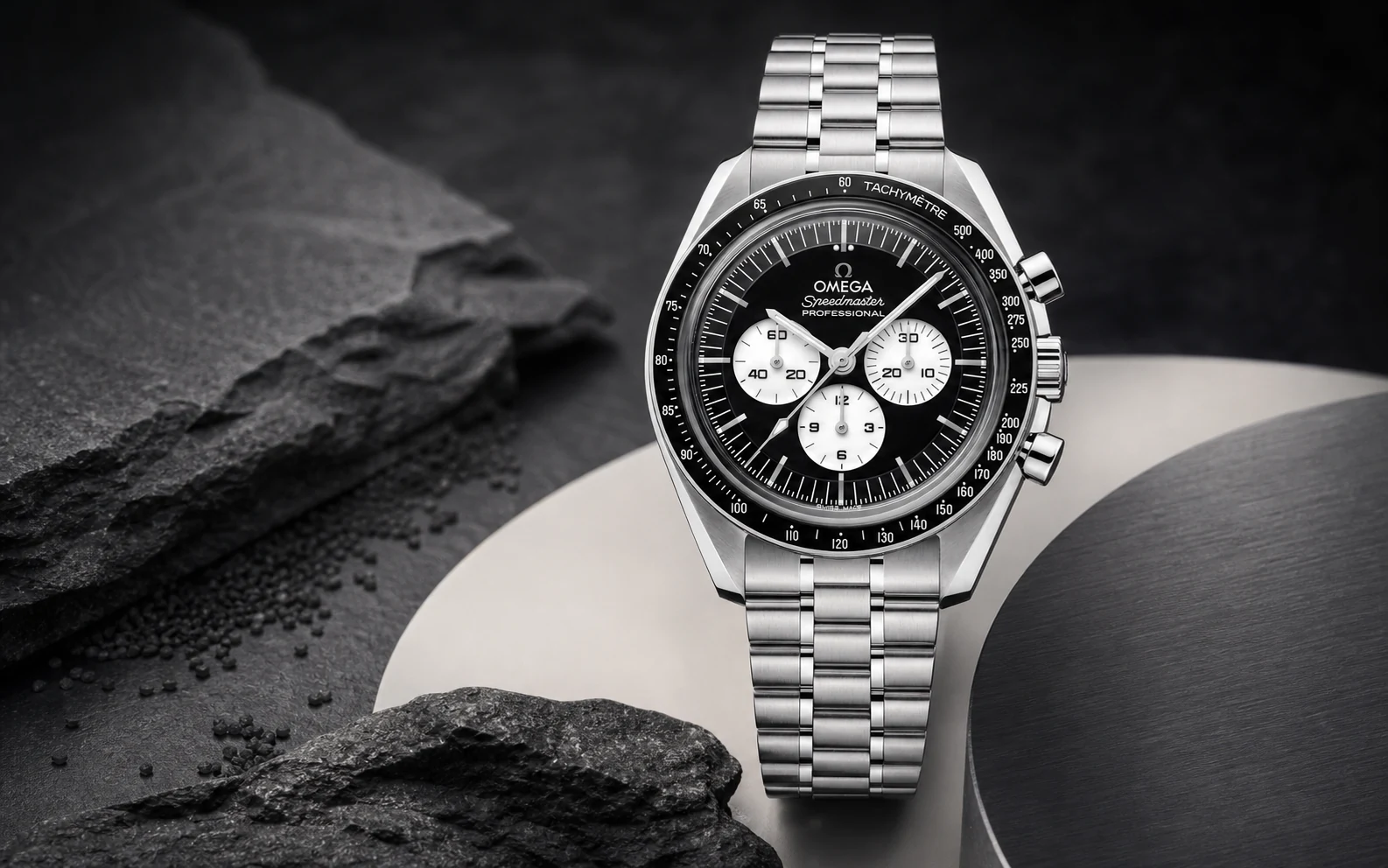
The hard part about buying one Omega is not choosing Omega. It is that the range spends most of its energy competing with itself. The Moonwatch has the legend and everyone knows it, which means the real question is whether you want the legend or you want the watch that will still be on your wrist in month eight, when the novelty has worn off and you are just getting dressed.
A few things are worth knowing before any of the individual watches make sense. Six of these carry Master Chronometer certification, tested by METAS and resistant past 15,000 gauss: the Aqua Terra 41, the Moonwatch, the Diver 300M, the First Omega in Space, the Planet Ocean and the Snoopy. That is not marketing decoration. It is the difference between a watch you trust without thinking and a watch you occasionally check against your phone. The De Ville is the exception that matters, running the older 2500 Co-Axial, a full generation behind everything else here.
The other thing to fix in your head is thickness, because it decides more about daily life than dial colour ever will. Two watches here are genuinely slim, the quartz Aqua Terra 28 at 9.51 mm and the De Ville at 9.75. One is genuinely large, the Planet Ocean at 16.09. Everything else sits in a band between 12.65 and 14.47, which is close enough that the differences inside it come down to how a case is shaped rather than how tall it is.
The three Speedmasters all use the same hand-wound 3861 with 50 hours in reserve, and all three are rated to 50 m. Those numbers cannot separate them, so ignore them once you have accepted them. What separates them is bezel material, lug width, what the watch arrives on, and a millimetre of height.
The ranking
10 picks

No. 01
Turquoise lacquer dial
Omega Seamaster Aqua Terra 150M ref. 220.10.41.21.03.006
A dial you buy on purpose, with the longest reserve on this list sitting behind it.
- 41 mm
- 13.26 mm thick
- 8900 · 60 hours
- 150 m
Why it’s here
Start here if you want the watch to be the interesting thing you are wearing. The dial is a turquoise lacquer that runs to black at the edge, and it is not a colour that lets you forget it is there. That is the entire proposition. If the idea makes you slightly nervous, that nervousness is information.
The butterfly clasp has Omega's comfort adjustment built in, so you can move the bracelet a fraction when your wrist swells in the heat, and it is the sort of small engineering you stop noticing because it works. There is 150 m of water resistance and a window in the back if you like looking.
Why it stands out
- Sixty hours in reserve: The 8900 holds 60 hours, which it shares with the Planet Ocean and which nothing else here matches. Take it off on a Friday evening and it is still running on Sunday night.
Watch-outs
- Integrated bracelet: At 47.91 mm lug to lug the proportions are right for most wrists, and the lugs are the standard 20 mm, but an integrated design means the bracelet is part of the watch's identity rather than an accessory to it. If you are the kind of person who rotates straps by mood, you will feel boxed in.

No. 02
Omega Speedmaster Moonwatch Professional ref. 310.30.42.50.01.004
The most practically built of the three Speedmasters, which is not what the reputation prepares you for.
- 42 mm
- 13.54 mm thick
- 3861 · 50 hours
- 50 m
Why it’s here
Set the story aside and this is still the most practically built of the three Speedmasters, which is not what most people expect. Its lugs are 20 mm, so straps are a solved problem rather than a hobby. And it arrives on a bracelet with a foldover clasp that has a comfort setting in it, where the Snoopy arrives on fabric and a pin buckle. If you are buying one Speedmaster and you want it to behave like a normal watch on a normal morning, that stack of small things is the argument.
The bezel is ceramic, which is the reason it will look the same in ten years and also the reason it reads harder and glassier than aluminium. The dial is a stepped double plate rather than a flat printed surface, so it has actual depth in it when light moves across, and there is sapphire in the back.
On the wrist
It is the largest of the three Speedmasters at 42 mm and yet it reaches 47.5 mm across the wrist, half a millimetre less than the 39.7 mm First Omega in Space. At 13.54 mm it also sits almost a millimetre lower than the Snoopy.
Watch-outs
- The most restrained dial of the three: The reason to walk past it has nothing to do with the winding, which is a thirty second habit you either enjoy or should not be buying a hand-wound chronograph to avoid. It is that black is the most restrained dial of the three. The blue-grey and the silver further down both give you something to look at on a day when nothing is happening, and this one asks you to be satisfied with correctness.

No. 03
Wears every day
Omega Seamaster Diver 300M ref. 210.30.42.20.01.010
The one I would take if you want a single Omega that asks nothing of you.
- 42 mm
- 13.80 mm thick
- 8806 · 55 hours
- 300 m
Why it’s here
If you are buying one Omega and you want to stop thinking about it, this is the one I would take. It is black, it has a unidirectional bezel you can actually use for something, it is rated to 300 m, and the 8806 gives you 55 hours. It is the least demanding watch on this list. It does not need winding, it does not need explaining, it does not need a second strap, and there is nothing you would want to do in a normal year that it cannot come along for.
The Planet Ocean is rated to twice the depth, and that difference is real in the sense that it exists. It is also 2.3 mm taller and considerably heavier for water you are not going to be in.
On the wrist
The number nobody quotes and everybody should is 49.7 mm. That is its lug to lug, and it is the longest reach of any watch here we have the figure for. Thickness is a reasonable 13.8 mm, so on paper it looks like the sensible diver, but length across the wrist is what makes lugs hang over the edge and a bracelet sit badly. On a smaller wrist this is the specification that decides the purchase, and it is the one the marketing never mentions.
Why it stands out
- Laser-engraved wave dial: It sounds gimmicky written down, and in practice it means the surface changes as your arm moves instead of sitting there like paint.

No. 04
Omega Speedmaster First Omega in Space ref. 310.30.40.50.06.001
The warmer, more interesting Speedmaster, sold as the small one when it is not really smaller.
- 39.7 mm
- 13.38 mm thick
- 3861 · 50 hours
- 50 m
Why it’s here
This is the small Speedmaster, 39.7 mm instead of 42, and the reason to want it is not the size. It is the aluminium tachymeter bezel, which has a softer, warmer surface than ceramic and ages instead of staying pristine, and the blue-grey dial, which shifts depending on what light you are standing in. That is a watch with something going on in it. It closes on a butterfly clasp, so the bracelet has no visible break in it when it is on.
On the wrist
The smaller case does not actually take up less room. At 48 mm lug to lug it reaches further than the 42 mm Moonwatch, and at 13.38 mm it is only a fraction thinner. What you are buying is a narrower dial, not a smaller watch.
Watch-outs
- Nineteen millimetre lugs: Everything else in this group is 20 mm, which means every decent strap ever made fits it, and this one does not. You will spend evenings filtering for a width almost nobody stocks, and you will end up buying whatever exists rather than what you wanted.
No. 05
No bezel
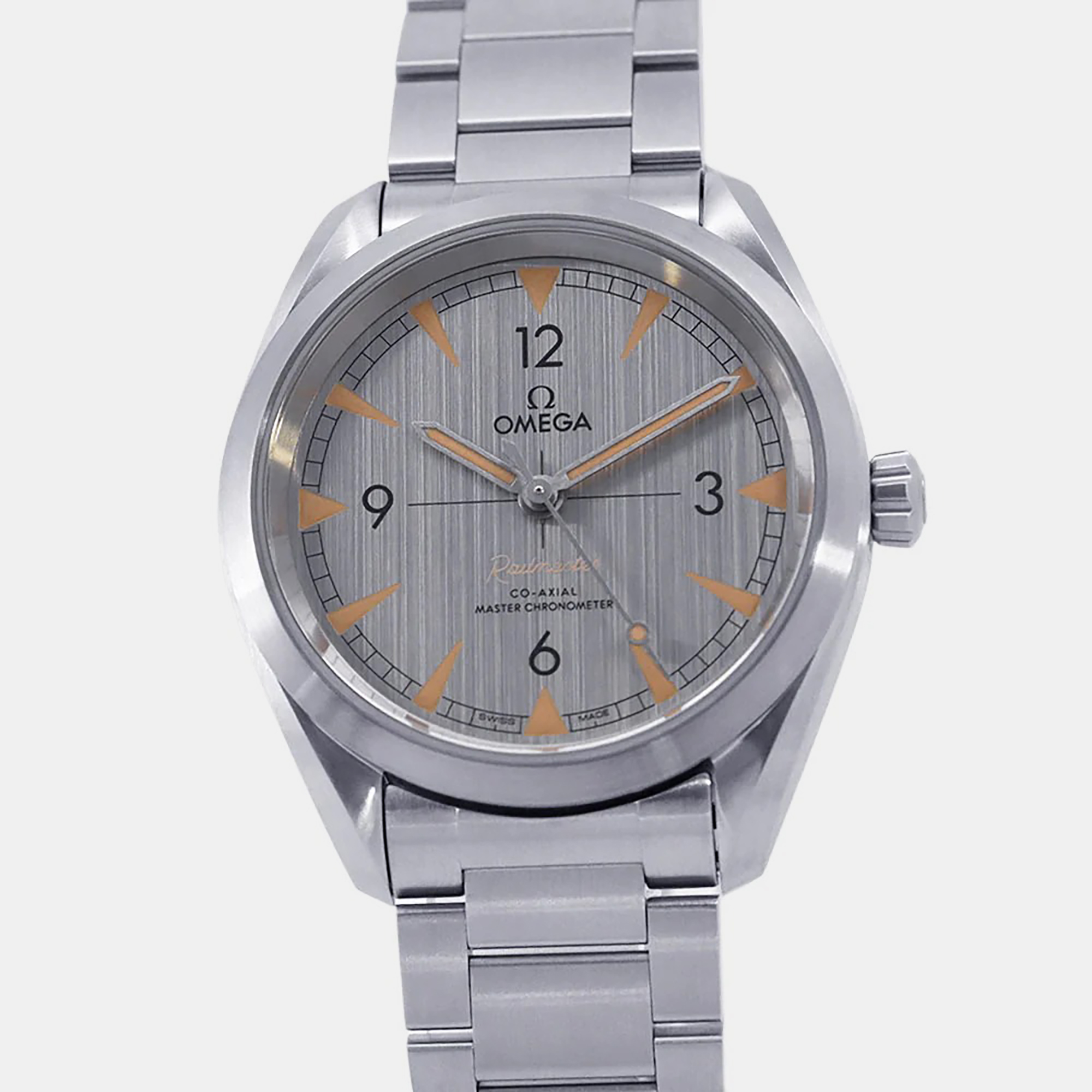
Omega Seamaster Railmaster ref. 220.10.40.20.06.001
Nothing between you and the time, which is the whole idea.
- 40 mm
- 12.65 mm thick
- 8806 · 55 hours
- 150 m
Why it’s here
The Railmaster has no bezel at all, and that is the whole idea. Grey dial, broad luminous hands, nothing sitting between you and the time. It reads instantly, which sounds like a small thing until you have owned a watch that does not. The 8806 gives 55 hours, 150 m is plenty for a life that includes rain and washing up, and at 12.65 mm it is the thinnest watch here that is not the De Ville or the quartz.

No. 06
Omega Seamaster Planet Ocean 600M ref. 215.30.44.21.03.001
Twice the depth you will ever need, and you feel every gram of it.
- 43.5 mm
- 16.09 mm thick
- 8900 · 60 hours
- 600 m
Why it’s here
The dial is blue and the 8900 inside gives it the same 60 hour reserve as the Aqua Terra 41, so a weekend off the wrist costs you nothing. It is discontinued. What the weight and the height buy you is depth capability far past anything you will personally attempt, which is either the point of the watch or the absurdity of it depending on your temperament. The people who own one and love it love it for the mass, not despite it. If you find yourself assembling reasons, that is usually the answer.
On the wrist
This and the Diver 300M answer the same question in completely different registers: 300 m at 13.8 mm, or 600 m at 16.09 mm and roughly 216 g on the bracelet. Two hundred and sixteen grams is not a number you glance at and forget. That is a watch you are aware of when you put a jacket on, when you rest your arm on a desk, when you lie down. Some people love exactly that and it is a legitimate thing to love.

No. 07
Omega De Ville Prestige ref. 424.10.40.20.01.001
The only one that goes under a cuff, running the oldest movement on the page.
- 39.5 mm
- 9.75 mm thick
- 2500 · 48 hours
- 30 m
Why it’s here
At 9.75 mm and 44.8 mm across, this is the thinnest mechanical watch here, beaten on paper only by the quartz Aqua Terra 28. It slides under a cuff without catching, which no other mechanical watch here manages, and the sunburst black dial keeps enough light in it that the watch does not vanish entirely. There is a steel bracelet with a sliding clasp and a window in the back.
The awkward part is the movement. It is a chronometer on the 2500 Co-Axial with 48 hours, a full generation behind everything else in the range, and it is rated to 30 m, which is the lowest figure here by a distance. So the one watch that solves the dress problem is also the one asking you to accept the oldest engineering and the least protection from water. You are buying a silhouette rather than a specification. That trade is fine for plenty of people, and it is only a problem if you were expecting the specification to justify it.

No. 08
Quartz, on purpose
Omega Seamaster Aqua Terra 28 mm ref. 220.10.28.60.51.001
Small, slim and correct every single time you look at it.
- 28 mm
- 9.51 mm thick
- Quartz 4061
- 150 m
Why it’s here
This shares a name with the Aqua Terra 41 and almost nothing else. It is quartz, it is 9.51 mm thick, and it reaches 33.9 mm across, which makes it by a wide margin the smallest thing here. There are four diamonds where hour markers would otherwise be, and the caseback is solid steel with an embossed Seahorse on it instead of a window, which is the right decision on a watch this size.
Quartz is the part people flinch at and the part that makes it good. You set it once and it is right every single time you look, for an official 48 months before the battery needs attention. Four years of never thinking about a watch is a genuine quality, and it gets dismissed far too quickly by people who would rather own something that drifts with more dignity. It keeps 150 m of water resistance, so nothing about the size makes it delicate. The 14 mm lugs rule out strap changes, though the bracelet is integrated, so the question was never open.

No. 09
Pre-owned example
Omega Constellation 35 mm ref. 368.1201
A design with no middle ground, bought on condition rather than specification.
- 35 mm
- Automatic
- Steel
- Pre-owned
Why it’s here
The four claws are either the most interesting detail on this page or a deal-breaker within three seconds of seeing them, and there is no middle position available, which I respect in a design. The rest of it is quieter than that suggests: a blue dial in a 35 mm steel case, an integrated bracelet, automatic, and pre-owned.

No. 10
Omega Speedmaster “Silver Snoopy Award” 50th Anniversary ref. 310.32.42.50.02.001
The silver dial is the reason, and it costs you a millimetre of height and a bracelet.
- 42 mm
- 14.47 mm thick
- 3861 · 50 hours
- 50 m
Why it’s here
The silver dial is what makes this one different, and it changes more than a colour swap should. Against silver, the ceramic tachymeter bezel stops being a ring around the edge and starts working as a frame, and the whole watch reads brighter and less serious than the black one. It takes up the same room on a wrist as the Moonwatch, 47.5 mm across.
Whether the dial is worth a millimetre of height and a strap you may want to replace is the only real question, and for a watch you will still be pleased to look at on a dull Tuesday, I think it usually is.
Watch-outs
- Thickest of the three: At 14.47 mm it is nearly a full millimetre over the Moonwatch, and a millimetre is exactly the amount you notice when a shirt cuff has to pass over it.
- Textile strap: It arrives on a textile strap with a pin buckle rather than a bracelet. That is charming and it suits the watch, and it also means the standard way to wear it is fabric, and a bracelet is a separate purchase and a separate decision.
If you are only buying one
The Diver 300M is the answer for most people, and it is the one I would take. It is rated to 300 m, the bezel does something, the 8806 gives you 55 hours, and there is nothing about it that needs managing. Try it against your own wrist first, because it reaches further across than anything else here we have a figure for. Everything after that is a preference rather than a correction.
You want the watch to be noticed
The Aqua Terra 41. The turquoise dial is the whole reason to own it, and the 60 hour reserve means a weekend off the wrist costs you nothing. Accept that the bracelet is not going anywhere.
You want a chronograph
The Moonwatch if you want it to behave like a normal watch, with 20 mm lugs and a bracelet you can adjust. The First Omega in Space or the Snoopy if you would rather have a dial with more going on and can live with an awkward lug width or a fabric strap.
You want it under a cuff
The De Ville if it has to be mechanical, on the understanding that you are buying a silhouette and an older movement. The quartz Aqua Terra 28 if being right every single time matters more to you than having something to wind.
Browse all Omega watches Explore more Top Lists
We ranked these exact references by design, proportion, specification and everyday usefulness. Offers are checked periodically and can change.