
Saudi Luxury / Editorial
The Rado Story: Unraveling The History And Intricate Details Of A Swiss Watchmaking Giant
Rado's history from 1917 through hardmetal and ceramic, what those materials do well and badly, and what the DiaStar, Captain Cook and Integral cost in Saudi Arabia.
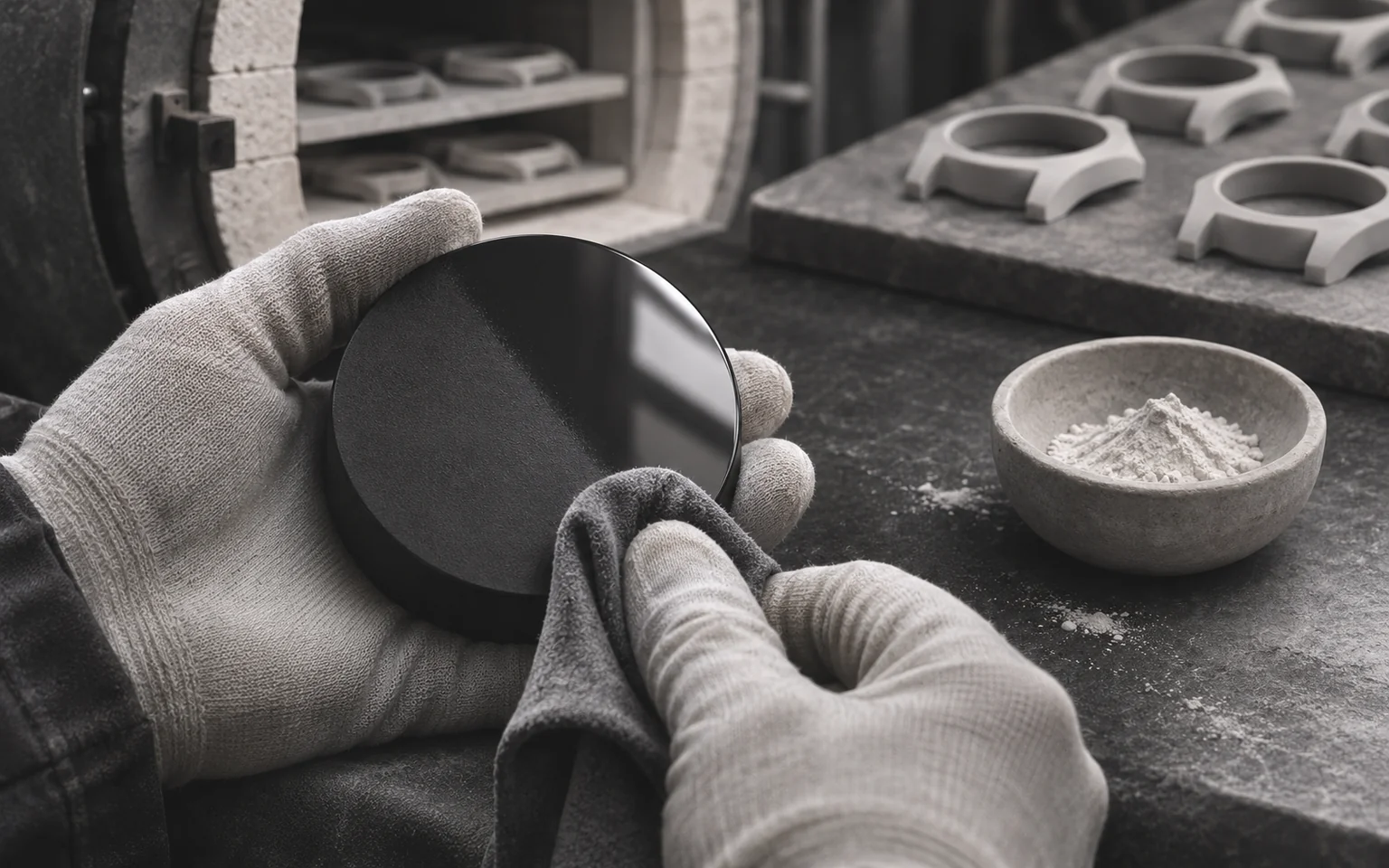
Rado made its name with cases that resist scratches, first in tungsten carbide on the DiaStar of 1962 and then in ceramic on the Integral of 1986. Its watches start at about SAR 4,000 on Amazon.sa.
These materials have a weakness as well as a strength. They resist scratches far better than steel, and they can chip or crack if they are hit hard. Rado’s own service pages say ceramic is not indestructible. This page follows the materials through the watches and ends with a table of what the current ones cost.
| 1917 | Schlup & Co. starts making watch movements in Lengnau |
|---|---|
| 1957 | The company takes the name Rado |
| 1962 | The DiaStar and the Captain Cook |
| 1986 | The Integral, with a ceramic case and bracelet |
| 1990 | The Ceramica |
| 2011 | The True Thinline, with a case in one piece of ceramic |
| 2019 | The 42 mm Captain Cook, rated to 300 m |
| 2022 | The DiaStar redesigned for its sixtieth year |
Movements for other people, 1917
Three brothers, Fritz, Ernst and Werner Schlup, founded Schlup & Co. in Lengnau in 1917 to make movements for other watchmakers. Watches signed Rado went on sale in 1954, and the company took the name in 1957. It is generally thought to come from the Esperanto word for a wheel, though the choice is not conclusively documented.
Rado joined the Swiss group ASUAG in 1968, and through a series of mergers it is now part of the Swatch Group, alongside Omega, Longines and Tissot. One of its first lines under its own name, the Golden Horse, was reissued in 2019 in an edition of 1,957, and the Anatom of 1983 returned in 2023 at €3,750 in Europe. We have pages for the Golden Horse and for a 2025 Anatom, neither with a current price.
A watch sold as scratch-proof, 1962
In November 1961 Rado filed a patent for a watch case made of hardmetal, a tungsten-carbide material used for cutting tools. The DiaStar followed in 1962, with that case and a sapphire crystal, and Rado sold it as the first scratch-proof watch.
The current DiaStar Original R12160303 keeps the wide oval shield over a small dial. It is 38 mm across and 12.1 mm thick, with an 80-hour automatic movement and a 100 m rating. The shield is now Ceramos, Rado’s name for a blend of titanium carbide and metal, and the designer Alfredo Häberli reworked the case in 2022, cutting the facets on the crystal from twelve to six.
It was SAR 8,252.90 on Amazon.sa on 12 November 2026. Over the 175 days before that our records ran from about SAR 7,140 to SAR 8,210, so this is a price to wait out. The 35 mm DiaStar Original automatics on Amazon.sa start much lower. The cheapest, in gold colour, was SAR 3,999 on 9 November.
The Captain Cook
Rado launched a dive watch in the same year as the DiaStar and, by one account, made it until 1968. The name is reported to have come back in 2017, and the 42 mm version arrived in 2019 with a 300 m rating.
The R32138303 is a showy example of it. It is 42 mm across and 12.3 mm thick, with a ceramic ring in the bezel, a dial that shades from black to green and gold-coloured links in the bracelet. Its 80-hour movement is from the same family as the DiaStar’s. At SAR 12,870 on 12 November 2026 it was at the bottom of the range we have recorded over four months.
The plainer 39 mm Captain Cook, the R32223203, is the one I would choose, and it was not available on Amazon.sa when last checked on 9 November. The cheapest Captain Cook in stock was a 42 mm with a green dial, the R32505313, at SAR 9,108.01 on 11 November. The rest of the family is on the Captain Cook page.
Ceramic, 1986
Rado describes the Integral of 1986 as the first watch made in series with a case and bracelet of high-tech ceramic. The Ceramica followed in 1990, coloured ceramics in 1992, and by most accounts plasma ceramic in 1998. That last one is ceramic treated in a furnace until its surface turns a metallic grey, with no metal in it.
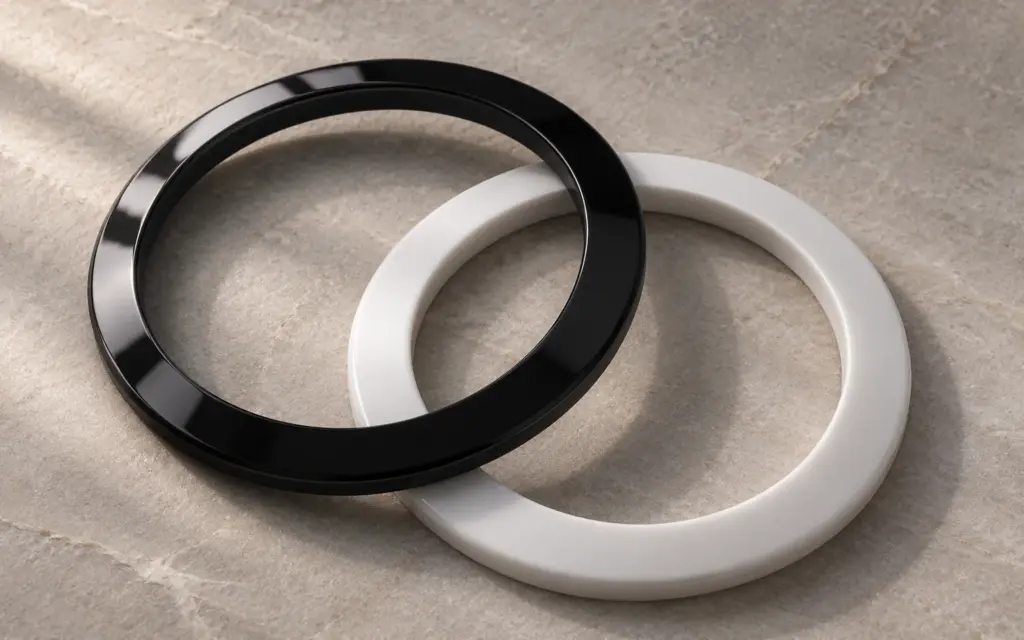
The material starts as a powder of zirconium oxide, mixed with pigment and a binder and injected into a mould about a quarter larger than the finished part. It is then fired at about 1,450°C, and it shrinks as it hardens. By Rado’s figures the result is about 1,250 on the Vickers hardness scale, several times harder than steel. The colour runs through the material, so it cannot wear off.
A steel case that is dropped usually dents and can be refinished. A ceramic one can crack, and a cracked part is usually replaced. I would think twice about a ceramic bracelet for someone hard on their watches.
Three of the ceramic lines on sale here show the range. The Integral is still made, as a quartz watch. The R27086162 is a True Square Automatic, with a square ceramic case and part of its movement showing through the dial. The True Thinline began in 2011 as a quartz watch in a one-piece case about 5 mm thick. The one we list, the R27090602, is an automatic in one of the nine Le Corbusier colours Rado introduced in 2019.
Rado has gone to outside designers several times for these watches. Jasper Morrison drew the r5.5 in 2009 and Konstantin Grcic reworked the Ceramica in 2016.
What they cost today
| DiaStar Original automatic, 35 mm, gold colour | SAR 3,999 on 9 November |
|---|---|
| Integral R20206712, 31 mm, quartz | SAR 7,794 on 10 November |
| Captain Cook R32505313, 42 mm | SAR 9,108.01 on 11 November |
| DiaStar Original R12160303 | SAR 8,252.90 on 12 November |
| True Square Open Heart R27086162 | SAR 11,288.30 on 11 November |
| True Thinline Le Corbusier R27090602 | SAR 12,789 on 11 November |
| Captain Cook R32138303 | SAR 12,870 on 12 November |
| Captain Cook 39 mm, R32223203 | Not available on 9 November |
| Anatom and Golden Horse | No current price |
Amazon.sa titles for Rado often leave out the reference number. Find it in the details of the listing, and check the dial colour against the photographs. Each watch’s own page shows today’s price.
Buying a Rado in Saudi Arabia
Rado’s own pages state a five-year international warranty on a new watch. A seller on Amazon.sa may not be an authorised retailer, so ask it to confirm in writing that the card will be honoured, and for how long.
A Rado boutique with a customer care centre is reported at Red Sea Mall in Jeddah. The report carries no date, and we could not confirm that the boutique is still open or find a Rado retailer in Riyadh. That matters for this brand, because a cracked ceramic case usually needs a part from Rado.
On a used Rado, look at the edges of the ceramic links and at the clasp under a strong light, and ask whether spare links come with the watch.
Sources and limits
History: Rado’s own history and product pages, Worn & Wound on ceramic, Monochrome, and the Historical Dictionary of Switzerland as cited by Wikipedia, read on 15 November 2026. Sources disagree on the years of Rado’s earliest models and of plasma ceramic. “The first” scratch-proof watch and “the first” ceramic watch made in series are Rado’s own claims.
Prices: Amazon.sa prices are as our records had them on the dates given. The euro price for the Anatom is Monochrome’s, from 2023.
Nothing here rests on having handled the watches.