
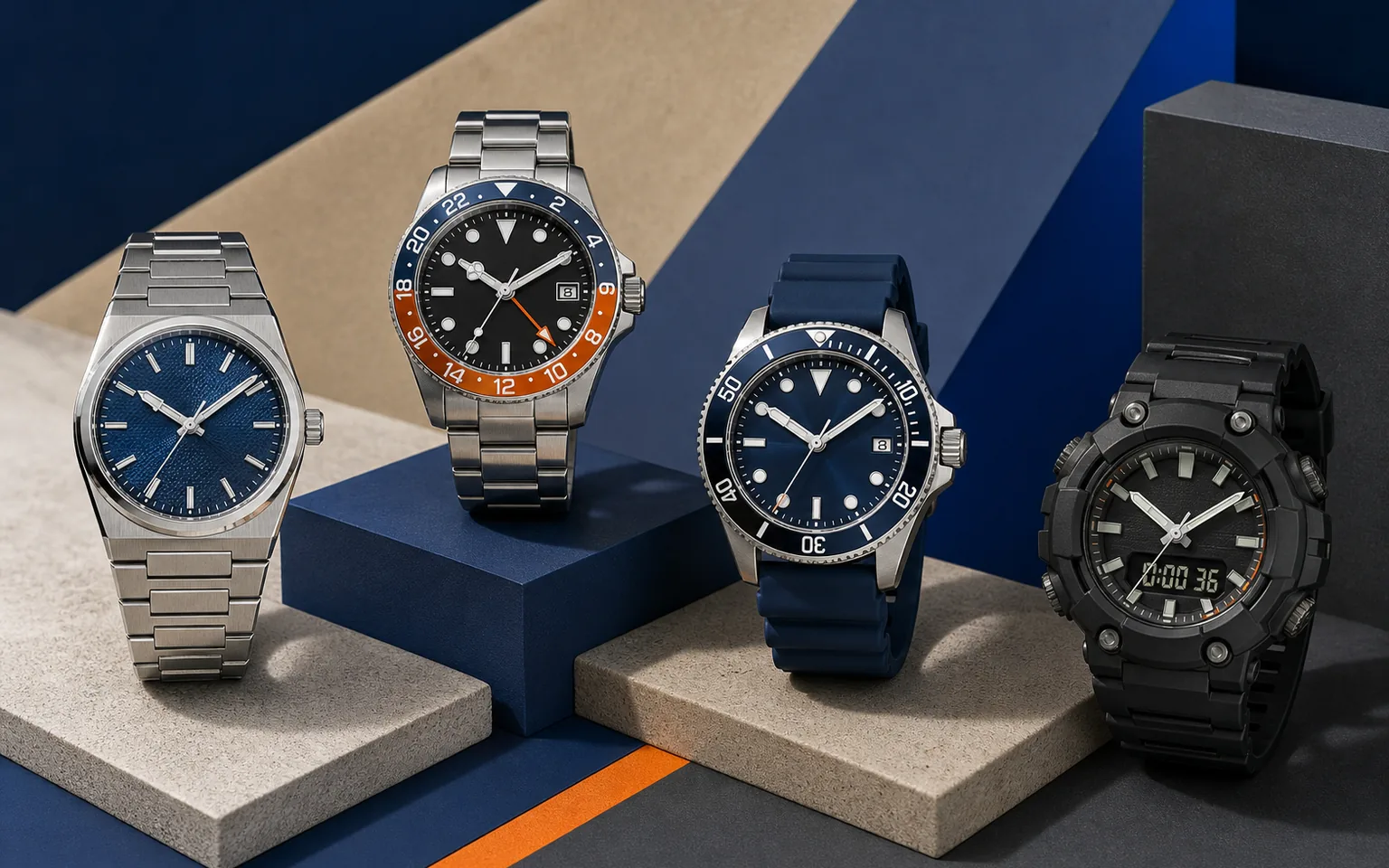
Every watch here is missing something, and none of the brochures tell you what. That is the actual decision. Not which one is best in the abstract, because at this money none of them is complete, but which missing thing you can live with.
Start with the glass, because it is the part of a watch you touch the world with. Sapphire shows up on the Tissot, the Orient, the Citizen Tsuyosa, the Casio Edifice and the Bulova. The Seiko 5 gets Hardlex. The G-Shock and the Citizen Promaster get plain mineral. So the two watches most likely to meet a door frame have the softest glass here, and a watch rated to 50 m of water has sapphire. The glass is not tracking toughness. It is tracking what the buyer of each watch is assumed to care about.
Two watches are missing from that paragraph and I am not going to paper over it. I have no crystal for the Seiko Prospex or the Q Timex. On a 200 m diver in particular that is the blank you would most want filled, and I would rather tell you the pattern has a hole in it than guess my way through it.
Size does the same thing. Diameter is the number everyone quotes and it is the one that tells you least. Lug to lug decides whether a watch sits on your wrist or hangs off it, and it does not follow diameter at all. The Tissot is 40 mm wide and 39.5 mm long, which is to say it is shorter than it is wide. The Orient has nearly the smallest diameter here at 39.9 mm and the longest case at 46.5 mm. Two watches that would read as the same size in a shop window will wear nothing alike.
And then there is power, which is the one nobody thinks about until it costs them. Solar means you never open the watch, until the sealed cell reaches the end of its life and you do. Automatic means never a battery and always a watch that loses time. Quartz means it is accurate, and one day it stops and needs a visit. Three ways to solve the problem, three new problems, none free.
The ranking
10 picks

No. 01
G-Shock GA-B2100-1AER
The GA-B2100 keeps the octagonal footprint of the GA-2100 and fills in the two things that model went without.
- 45.4 mm wide
- 11.9 mm thick
- Tough Solar · Bluetooth
- 200 m
Why it’s here
Module 5689 adds solar charging and time set from your phone over Bluetooth, plus world time, double LED lighting and power saving. So it never needs a battery visit, never drifts, and never needs setting when the clocks move. The Carbon Core Guard case, 200 m rating and resin strap are the same story they have always been.
On the wrist
It weighs 52 g. That is the number that matters here and the one you notice first, because on a case 45.4 mm across and 48.5 mm long the weight is what decides whether you register it at all, and at 52 g you do not.
Watch-outs
- The crystal: The corner is the crystal, and this is the watch that owns that complaint. Mineral, on the one most likely to be swung into a doorway, a car door or a weight rack. Casio know exactly what they are doing: the case protects the movement and the glass is a consumable. That is a defensible engineering decision and it is still the thing that will nag at you, because a scratch across the display sits between you and the time every time you look.
No. 02
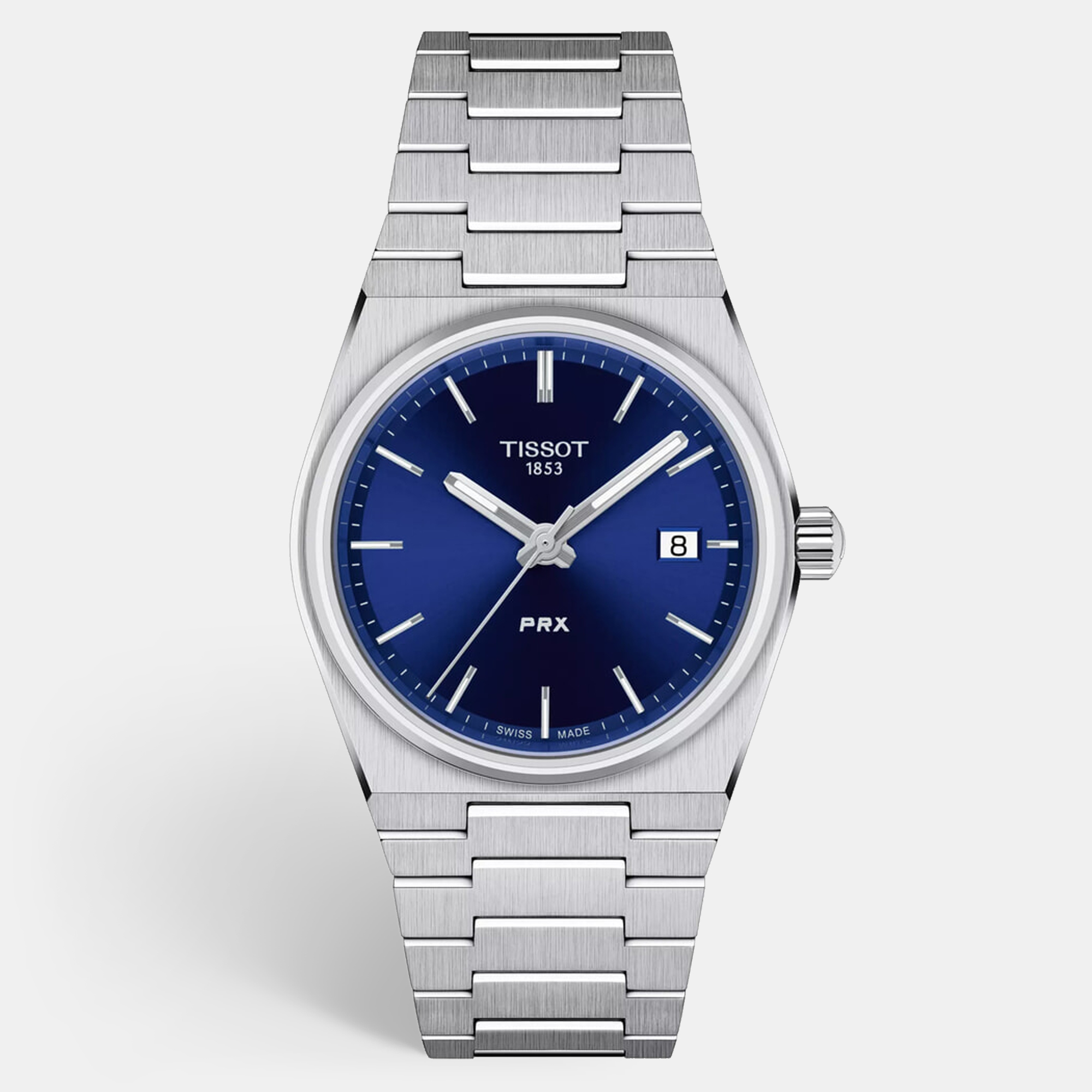
Tissot PRX Quartz T137.410.11.041.00
The PRX is the one here that reads as a designed object rather than a specification.
- 40 mm
- 10.4 mm thick
- Swiss quartz
- Sapphire · 100 m
Why it’s here
Steel, sapphire, 100 m, Swiss quartz, butterfly clasp. At 10.4 mm it is the flattest thing on this list, and combined with that short case it stays inside the flat of the wrist and under a cuff in a way nothing else here manages.
Watch-outs
- The bracelet: The bracelet is where the trouble lives. It is integrated, with a 12 mm attachment, which in plain terms means you cannot put a strap on it. Ever. Not a rubber strap for the summer, not leather when you want it dressed down, nothing. You are buying one watch in one configuration for the life of the watch. If you are the sort of person who owns two straps for everything, this will grate within a month. If you were only ever going to wear it on the bracelet, it costs you nothing at all.
No. 03
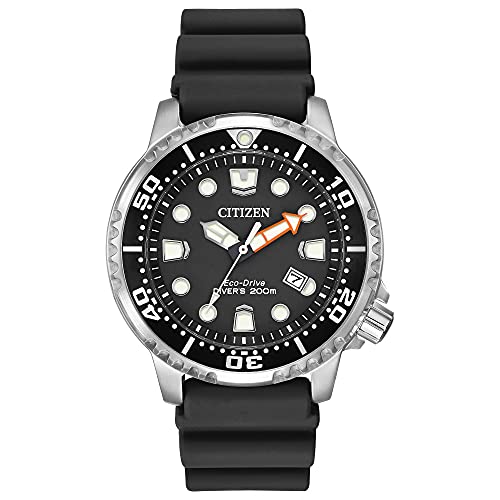
Citizen Promaster Diver BN0150-28E
Four watches on this list are rated to 200 m. Only this one claims ISO dive certification.
- 44 mm
- 93.55 g
- E168 Eco-Drive
- ISO · 200 m
Why it’s here
That distinction is worth more than the depth number itself, because 200 m on a caseback is a pressure figure and a dive certification is a set of requirements about the bezel, the legibility, the shock resistance and the strap. Most people will never dive. The point is that one manufacturer submitted to an external standard and the others quoted a number.
The solar bill comes due eventually, in the sense that the cell has a finite life and the day it ends the watch has to be opened. That is one appointment somewhere far out, against an automatic asking you to correct it every week.
On the wrist
It is 44 mm, with a one-way rotating elapsed-time bezel, a rubber strap on a plain buckle, 20 mm lugs, and the E168 solar movement. About 94 g, which for a 44 mm 200 m diver is light, and that is the rubber strap doing the work.
- Choose it over
- The 20 mm lugs are standard, so the strap is a choice rather than a condition of ownership, which is exactly what the PRX cannot offer you.

No. 04
Seiko 5 Sports GMT SSK003
This is the only mechanical second time zone here, and if you actually run two zones, that ends the argument.
- 42.5 mm
- 13.6 mm thick
- 4R34 · 41 hours
- 100 m
Why it’s here
The SSK003 runs the 4R34 with 41 hours of power, a blue dial, a rotating 24-hour bezel with a Hardlex insert, 100 m, 22 mm lugs and a three-fold clasp with a secure lock. Nothing else on the list does the job at all, and no point about crystals or thickness outweighs a function you use daily.
On the wrist
It is also the biggest thing here in the ways that count: 42.5 mm wide, 46 mm long, 13.6 mm thick, the thickest on the list. Which is a strange result, because the watch that stands tallest on the wrist is not one of the divers.
Watch-outs
- The caseback: Seiko put a see-through window in the back of a 100 m sports watch and Hardlex over the front. The glass you look at all day is the compromise and the glass you will never look at is a display panel over a movement that is not decorated. My position on this does not move for the rest of the list: a window in the back is a fine idea on a watch you are not going to abuse and a bad trade on one you are. I would take a solid back and sapphire in front without thinking about it.
No. 05
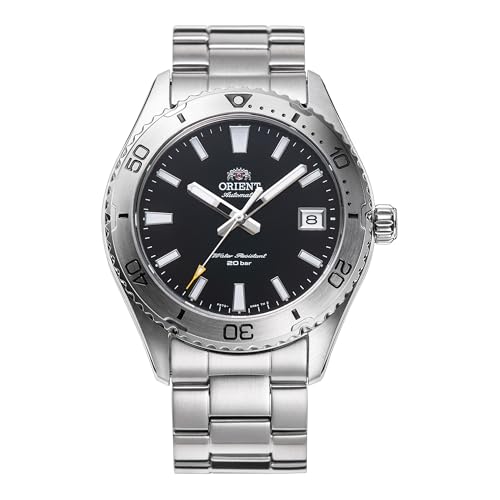
Orient Diver Design 40 RA-AC0Q01B
Plus 25 to minus 15 seconds a day. Start there, because it is the price of everything else on this watch.
- 39.9 mm
- 12.8 mm thick
- F6722 · 40 hours
- 200 m
Why it’s here
Forty seconds of possible spread means resetting it regularly rather than occasionally, and it is the corner Orient cut to hand you flat sapphire, 200 m, a screw-down crown and caseback, JIS Type 1 antimagnetic and a steel bracelet with a trifold and security latch. The F6722 gives 40 hours. It launched in June 2023, and it is the most specification on the page by some distance.
The geometry is the other thing to weigh. Nearly the smallest diameter here on the longest case, and Orient publish a 140 to 200 mm wrist range, which is unusually forthcoming of them and worth taking seriously, because a case this long on a wrist near the bottom of that range will overhang. It is also 165 g, more than three times the G-Shock, which is what a full steel bracelet and a screw-down case weigh.

No. 06
Citizen Tsuyosa 37 mm NJ0200-50L
Fifty metres. Three watches here stop at that figure, but this is the only automatic among them, and that is the corner.
- 37 mm
- Sapphire crystal
- 8210 automatic
- 42 hours
Why it’s here
An automatic you have to take off before anything wet is a different kind of nuisance to a quartz you do the same with. Everything else about the Tsuyosa is generous for what it is: sapphire, an ice blue dial, the 8210 automatic with 42 hours, and a fold-over clasp with push buttons. It is a 37 mm unisex watch. Its exhibition caseback is the case where I have no complaint, and that is consistent rather than convenient. This watch is not claiming to be a tool, so the window in the back costs it nothing at all.
On the wrist
At 37 mm and 11.5 mm thick it is the smallest thing here and it will fit people the rest of this list will not.

No. 07
Seiko Prospex Solar Diver SNE597
The Citizen has the dive certification and the Seiko has the proportions, and that is the trade in one line.
- 41 mm
- 11.3 mm thick
- V157 · 10 months
- 200 m diver
Why it’s here
It is a 200 m diver, and the V157 gives roughly ten months from a full charge, which means it survives a drawer and is still correct when you pick it up.
Which brings me back to the hole in my own argument. I have no crystal for this watch, no weight, no bracelet detail and no lug to lug. On a 200 m diver those are exactly the things that decide how it lives, so treat the case as the part of the picture I can vouch for and the rest as genuinely unknown here.
- Choose it over
- The comparison worth making is with the Promaster, because these two are the only solar divers here and they solve the same problem differently. The SNE597 is 41 mm to the Citizen's 44 mm, and 11.3 mm thick, and on most wrists that is the more wearable of the two by a clear margin.

No. 08
Casio Edifice Automatic EFK-100D-3AER
Casio spent fifty years arguing for quartz and in 2025 they built a mechanical watch, which makes this either the most interesting thing on this list or a novelty. It is the former.
- 39 mm
- 12.5 mm thick
- Automatic · hand winding
- 100 m
Why it’s here
Module 5755, 24 jewels, 21,600 vph, roughly 40 hours, automatic with hand winding, a green dial, sapphire and 100 m. There is unconfirmed talk about a Seiko base movement inside, which is talk and nothing more.
The corner is the same one I object to on the Seiko 5. A see-through screw-lock caseback on a 100 m case is a window where a solid back belongs. And the shape needs care: 39 mm wide but 43.5 mm long, so the Edifice reaches further across the wrist than the diameter promises, which is the same trick the Orient plays and the reason to check it against your own wrist rather than against a number you like.
- Choose it over
- Sapphire plus hand winding on a first attempt is a more complete package than the Seiko 5 manages.
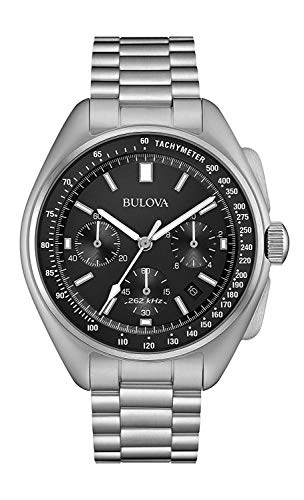
No. 09
Bulova Lunar Pilot 96B258
The Lunar Pilot has the single most interesting piece of engineering on this list.
- 45 mm
- NP20 · 262 kHz
- Chronograph
- 50 m
Why it’s here
The NP20 quartz runs at 262 kHz, which is why the seconds hand sweeps instead of ticking and why the chronograph resolves very fine intervals. Most quartz chronographs in any price range measure in fifths of a second and look like it. This one does not, so if you time things rather than admire the idea of timing them, this is the watch on the list built for it.
It is 45 mm, with sapphire, a black dial, a steel bracelet and 20 mm lugs. Forty-five millimetres is a lot of watch and it is faithful to the Archive Series original, so this is a reissue behaving properly rather than a modern misjudgement.
Watch-outs
- Fifty metres: Fifty metres is the part that sits badly with me here, not because it will fail in the rain, it will not, but because a chronograph this capable invites you to wear it doing things, and 50 m is a watch you take off before you swim.

No. 10
Q Timex 1979 Reissue TW2T80700
The self-adjusting clasp is the detail that makes this one work, because it solves the thing that makes an inexpensive bracelet miserable to live with.
- 38 mm
- 11.5 mm thick
- Quartz · day/date
- 50 m
Why it’s here
The rest is a 1979 reissue behaving like one: 38 mm, 11.5 mm thick, blue dial, 18 mm lugs, 50 m, quartz with day and date, which is the reason to want this one rather than a modern shape. At 38 mm it is the second watch here that will fit a smaller wrist properly.
Its corner is the glass I cannot name, and 50 m alongside it. Being unable to tell you what is over the dial on a watch this size is a real gap, not a formality, and it is the second time on this list I have had to say so.
What I would tell a friend
Buy the Citizen Promaster. Here is the part I have to argue rather than assert, because I have just spent a paragraph telling you that mineral crystal is the flaw you look at every day.
The difference is that the crystal is the only compromise on this list that is repairable and does not touch what the watch is for. Marks on the glass are a nuisance you can undo. Everything else here is structural: the PRX will never take a strap, the Seiko 5 will always be 13.6 mm thick, the Orient will always drift across that forty second window, and the two watches whose glass I cannot even name will always be an unknown. You cannot undo any of those.
And the certification is not really about diving. Most people never will. It is the only external check anywhere on this list that someone else tested the bezel, the legibility, the shock resistance and the strap, which is a fair description of what ordinary daily abuse actually does to a watch. A solar movement means you never open it, standard lugs mean you can change how it looks whenever you like, and about 94 g means you will keep it on. For a first or second proper sports watch, that is the one with the fewest ways to disappoint you, and it is the one I would put my own money on.
Explore the best dive watches Explore more Top Lists
We ranked these exact watches by capability, fit, movement logic and build. Offers are checked periodically and can change.