
Saudi Luxury / Buyer’s Guide
Rolex Pepsi 126710BLRO
A current Saudi guide to Rolex Pepsi 126710BLRO asking prices, estimated landed costs, bracelet choice, catalogue status and the checks that separate a good watch from a good purchase.
The decision in one minute
A travel watch first. A market story second.
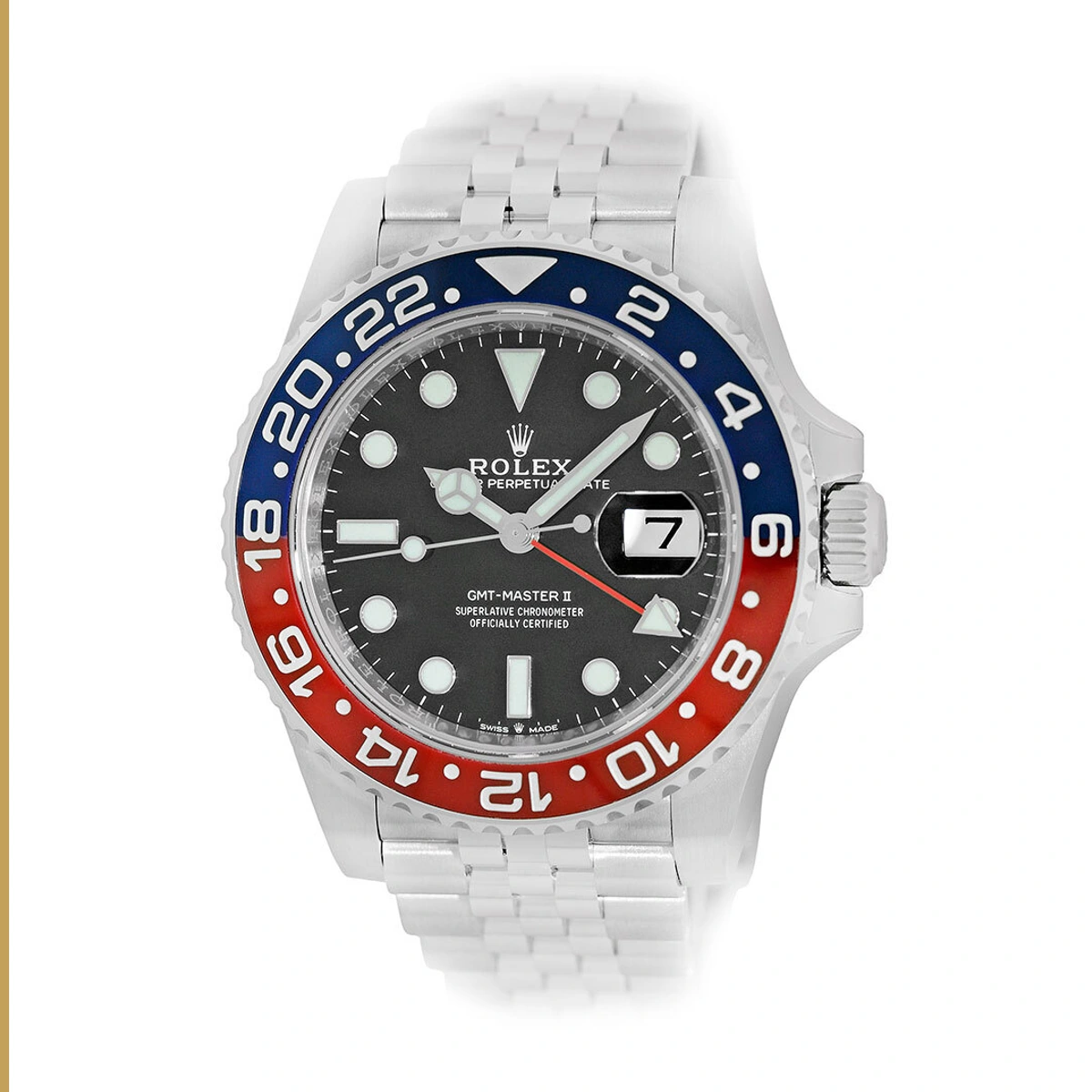
The 126710BLRO is the modern steel “Pepsi”: a 40 mm Oystersteel GMT-Master II with a black dial and red-and-blue ceramic bezel. It arrived on Jubilee in 2018; Oyster followed in 2021.
It earns its place through function, colour and bracelet character. The 2026 catalogue change is context, not a reason to rush.

How the 126710BLRO wears and works
Calibre 3285 makes sense in transit. Fly from Riyadh to London and the local hour hand can jump back without stopping the watch, while the arrow-tipped 24-hour hand remains on Saudi time. The date follows the local hour in either direction. It is a small action that makes the watch feel designed for travel rather than decorated around it.
Current market imagery
See it in current listings
A rotating sample from the live 126710BLRO image pool.
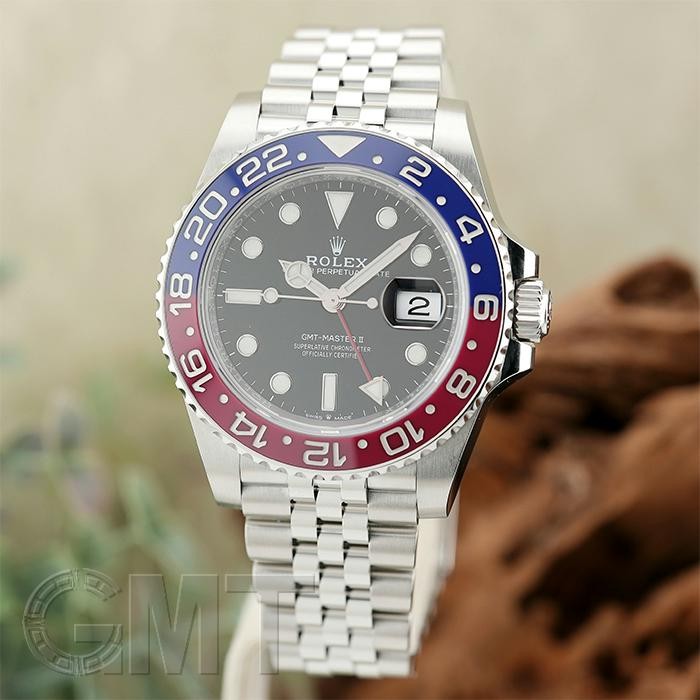


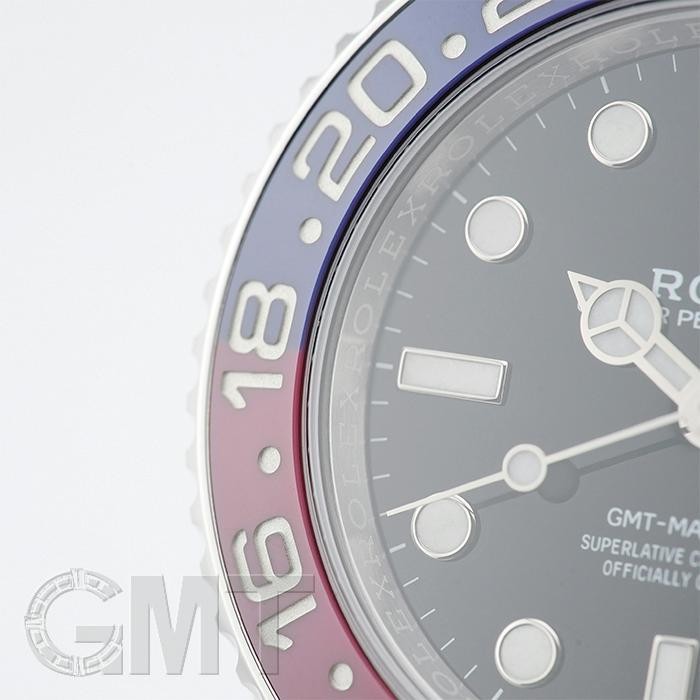
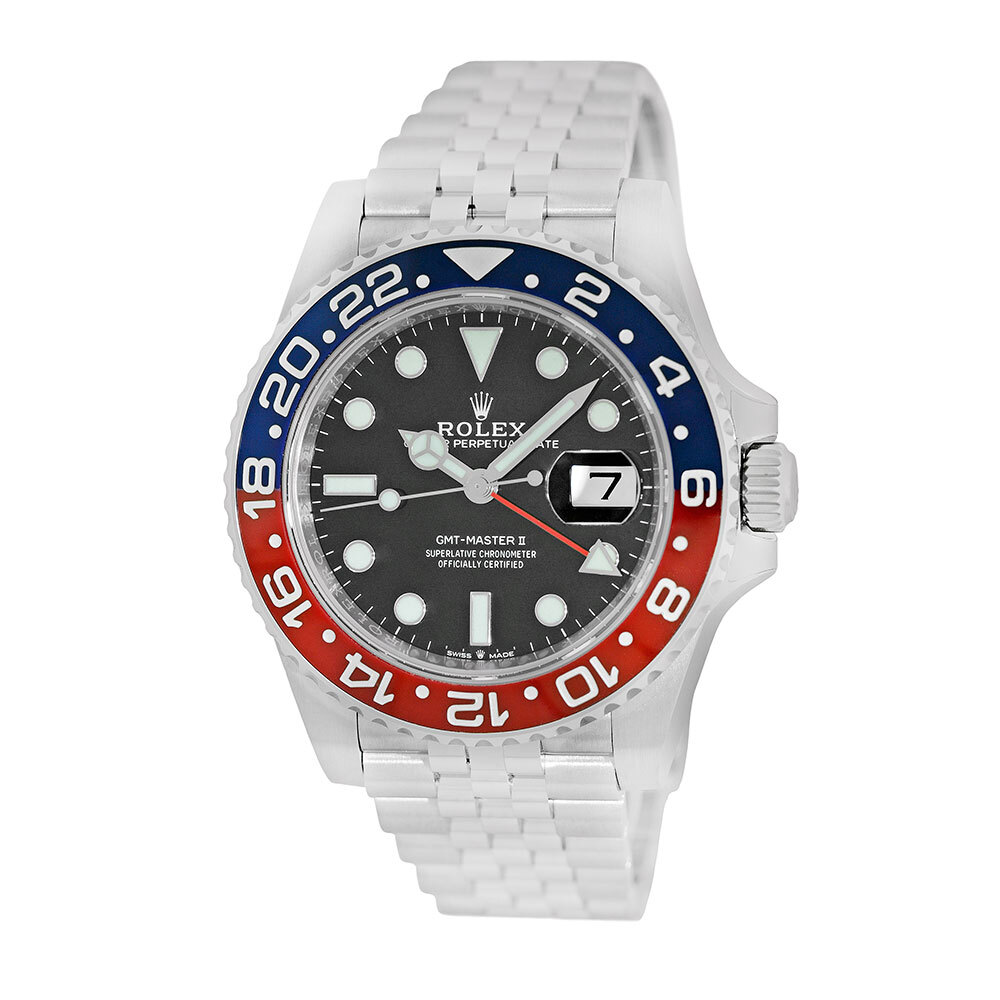


Images refresh with the reference feed. Bracelet, condition, seller and availability may differ.
The red and blue halves separate day from night at a glance; the black dial keeps the display orderly. A roughly 70-hour reserve, 5 mm Easylink adjustment and 100-metre rating make it easy to live with. On a pre-owned watch, pressure integrity should still be tested rather than assumed.
| Reference | 126710BLRO |
|---|---|
| Case | Oyster, 40 mm, Oystersteel |
| Bezel | Bidirectional 24-hour bezel with red-and-blue Cerachrom insert |
| Dial and crystal | Black Chromalight dial; sapphire crystal with Cyclops over the date |
| Water resistance | 100 metres or 330 feet |
| Movement | Manufacture Rolex calibre 3285, automatic GMT |
| Functions | 24-hour display, second time zone, independent local hour, instantaneous date and stop seconds |
| Precision | Minus 2 to plus 2 seconds per day after casing |
| Power reserve | Approximately 70 hours |
| Bracelet | Jubilee or Oyster; Oysterlock clasp and Easylink 5 mm extension |
| Certification | Superlative Chronometer, COSC plus Rolex certification after casing |
Fit remains more revealing than any table. Bracelet articulation, clasp position and the number of supplied links determine whether the watch sits naturally. Missing links are not a major defect, but replacing them after delivery adds expense and turns an exciting arrival into another piece of administration.
Jubilee or Oyster?
The Jubilee brings more light and texture. The Oyster is quieter and more direct. This is the most visible choice within the reference, and it changes the character of the watch more than the shared specifications suggest.
With five smaller links, the Jubilee catches more light and gives the case a more fluid transition to the wrist. It is also the configuration in which the steel 126710BLRO appeared in 2018. The three-link Oyster is calmer and more architectural. Its broader surfaces recede visually, allowing the red-and-blue bezel to carry the composition. Both use an Oysterlock safety clasp and an Easylink extension of approximately 5 mm.
| Decision point | Jubilee | Oyster |
|---|---|---|
| Variant | m126710blro-0001 | m126710blro-0002 |
| Construction | Five-piece links | Three-piece solid links |
| Character | More light, texture and bracelet presence | Cleaner, quieter and more tool-like |
| Launch context | Steel launch configuration in 2018 | Option added in 2021 |
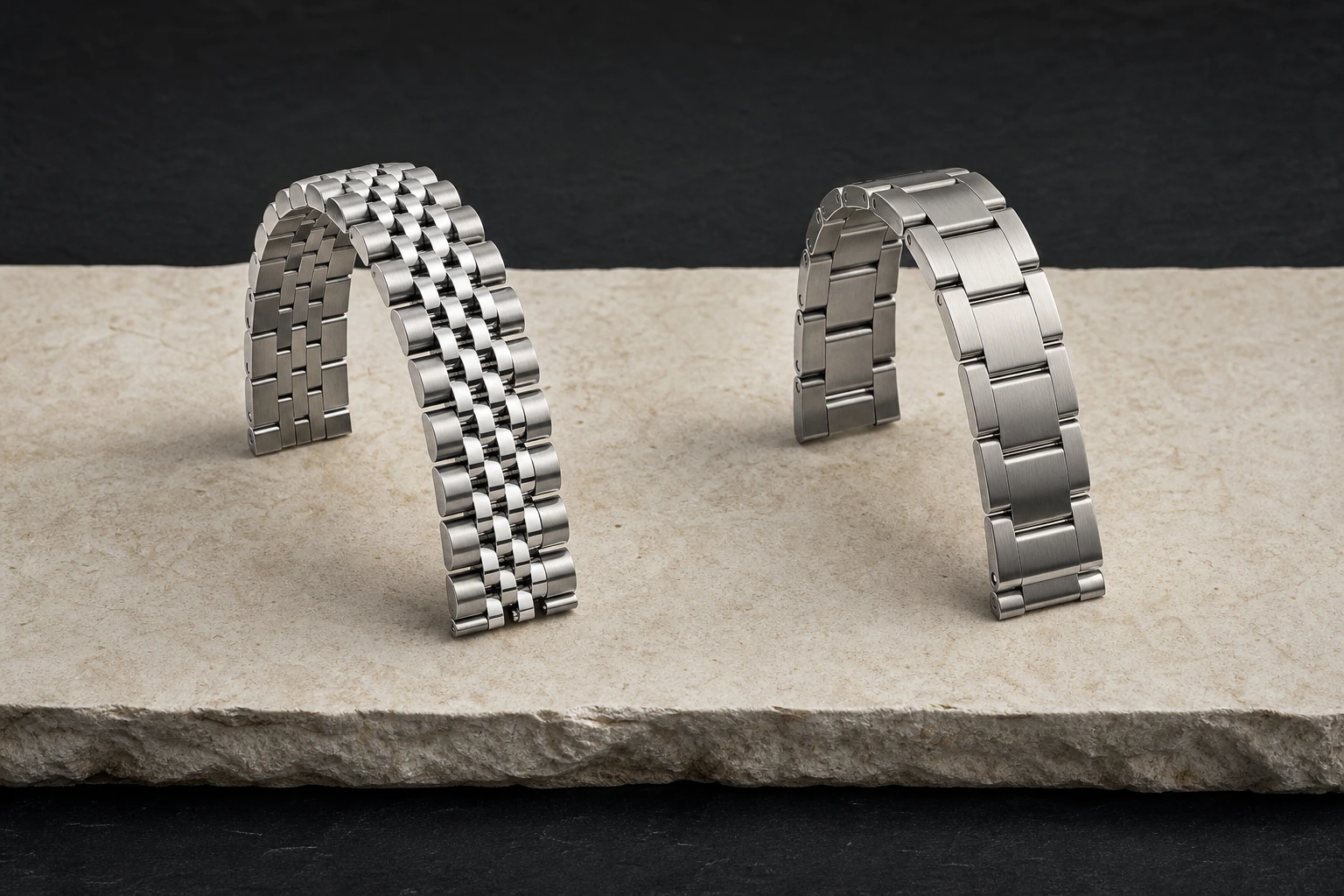
Comfort is personal. The Jubilee’s smaller links may conform more readily to one wrist; another wearer may prefer the broader feel and simpler appearance of the Oyster. Try both when possible. For an overseas purchase, request a wrist-level video and confirm that all removable links are included.
Choose Jubilee for the launch-era configuration and a brighter, more recognisably Rolex interplay of polished and brushed surfaces. Choose Oyster when you want the bezel and case to dominate. In either form, a crisp, complete and honestly described example is preferable to the “right” bracelet attached to a compromised watch.
Why the Pepsi design matters
The nickname came later. The colours began as information. Rolex launched the GMT-Master in 1955 as long-distance air travel was reshaping the idea of time; the two-colour bezel separated day from night. In 1982, the GMT-Master II added the independently adjustable local hour hand that still defines the watch today.
The modern red-and-blue bezel required a different kind of work. In 2014, Rolex introduced a monobloc Cerachrom insert in the two colours on a white-gold GMT-Master II, describing the process as a major technical challenge and a world first. The steel 126710BLRO followed in 2018 on Jubilee, pairing the ceramic bezel with calibre 3285. The Oyster bracelet joined the reference in 2021.

The result feels familiar without being a reproduction. The colours point backwards; the ceramic, movement and clasp engineering are contemporary. Catalogue status changes the availability of this reference, not the future of the colour idea. What you are choosing is this steel case, calibre, bracelet and period of production.
What changed in 2026
On 11 July 2026, reference 126710BLRO was absent from Rolex’s current GMT-Master II line-up, while its exact official model page remained online. Rolex had not issued a conventional announcement saying the steel red-and-blue watch, or the colour pairing itself, was gone for good.
Chrono24 recorded two sharp bursts of purchase requests and an initial fall in active listings. WatchCharts later reported that listings reached record levels and prices eased. That second move matters: higher prices drew more watches to market.
So what should you do with the news? Check when an offer was last revised, keep a walk-away figure and resist the idea that removal creates a deadline. The broader Rolex price-history report shows why recognition and scarcity do not remove timing risk.
How to choose the right example
A genuine Rolex can still be the wrong watch. Heavy polishing, missing links, undisclosed service parts, weak documentation or an impractical return policy can turn an apparently attractive price into an expensive compromise.
- Confirm the reference. It should be 126710BLRO: m126710blro-0001 on Jubilee or m126710blro-0002 on Oyster. Clarify any title mentioning another nickname, diamonds or custom work.
- Read the case before the dial. Soft lugs, rounded crown guards and blurred finishing transitions can reveal heavy refinishing.
- Ask for current images. Inspect the bracelet, clasp, bezel, crystal and removable links in close photographs and video.
- Establish originality. Service replacements can be legitimate; aftermarket parts create a different watch. Both should be disclosed.
- Reconcile the paperwork. Warranty card, invoice and service records should tell one coherent story, while never substituting for the condition of the watch itself.
- Inspect the seller. Verify who they are, where they trade and exactly how an international return works.
- Protect the journey. Use a payment route with recourse, full-value insurance and a written agreement on loss, customs reassessment and return shipping.
Seller labels such as “good” or “excellent” are not inspections. A dealer who answers precise questions, supplies complete photographs and offers a workable return may justify a higher price.
Does it make sense for you?
It makes sense when
- You want this red-and-blue GMT specifically, rather than whichever steel Rolex currently carries the strongest market story.
- You value the independent local-hour function and will enjoy using it while travelling.
- You can pay the secondary-market premium without requiring appreciation to vindicate the purchase.
- You are willing to compare several watches and reject one with weak condition, incomplete disclosure or poor terms.
Step back when
- The catalogue change is the principal source of urgency.
- The budget only works if the watch can later be sold near its advertised price.
- A blue-and-black GMT-Master II would satisfy you at a materially lower delivered cost.
- You do not want to manage international returns, customs questions, inspection and payment risk.
If the red-and-blue premium starts to obscure the watch, compare other GMT-Master II references, particularly the Rolex Batman 126710BLNR. For a wider route through the collection, current references and market reports, continue through the Rolex hub. If the purchase only works with a later resale, pause and read the Rolex resale-value guide.
The right Pepsi is the example whose condition, bracelet, completeness, seller and delivered price remain convincing after the excitement has subsided. Keep those five factors beside the current 126710BLRO offers.
Rolex Pepsi price in Saudi Arabia
Read three numbers separately: the seller’s asking price, the likely landed cost and the amount at which a watch eventually changes hands. Saudi Luxury shows the first two; completed sales are a different measure.

The SAR 23,432 gap between the two medians amounts to roughly 20.9 per cent of the median asking price. It is not a universal import rate. Saudi Luxury’s comparison model starts with the item price and stated shipping, applies an estimated 5 per cent customs duty, then applies 15 per cent VAT to the duty-inclusive subtotal. Customs classification, assessed value, insurance, courier charges, payment fees and exchange rates can change the final bill.
An advertised price is the beginning of an international purchase, not its full cost.
The sample is heavily concentrated in Japan. Forty-two of the 52 offers showed Japan as the seller or shipping origin; eight came from the United States, with one each from the United Arab Emirates and Germany. Japan therefore has an outsized influence on this dated Saudi-shipping sample. It does not follow that Japan represents four-fifths of global Pepsi trading, or that these watches were local Saudi stock.

A useful check is to take only the lowest estimated landed offer from each of the 13 sellers. The median of those seller-level lows was SAR 134,033, close to the full-cohort landed median. This reduces the influence of dealers posting several similar watches, although it cannot adjust for condition, year, completeness or return terms.
Global platforms provide context, not a substitute. WatchCharts displayed a modelled pre-owned estimate of USD 21,731 as of 29 June 2026. Chrono24 showed an average advertised price of about USD 26,000 when checked on 11 July 2026. The gap is not necessarily a contradiction. One is a modelled estimate, the other a marketplace average, and neither includes Saudi Luxury’s landed-cost assumptions.
The cheapest listing should therefore invite questions rather than admiration. Is the bracelet correctly identified? Is the watch complete? Have the case and lugs been heavily polished? Are the bezel, dial, hands and bracelet original or authorised service replacements? Can the watch be returned after an international shipment? Until those points are clear, the price is only a headline.
Methodology and sources
Saudi Luxury snapshot: The cohort was frozen on 11 July 2026, with the latest underlying offer observation dated 10 July 2026. The raw active set contained 55 listings. Three were excluded because their titles carried clear mismatch or alteration signals, including “Batgirl” or “Diamond”. The resulting cohort contained 52 relevant listings from 13 sellers. The exclusion improves comparability but does not independently validate every retained description.
Price definitions: Asking price means the seller’s advertised figure. Estimated landed price is Saudi Luxury’s comparison estimate, not a completed transaction, appraisal, customs ruling or guaranteed invoice. Offers and availability can change after the snapshot date.
Landed-cost model: The model used a USD to SAR conversion of 3.75, added stated shipping to the item price, applied an estimated 5 per cent customs duty to that subtotal and then applied 15 per cent VAT to the duty-inclusive amount. The model included a SAR 0 clearance charge. Final classification, assessed value, courier charges, insurance, payment fees and exchange rates may differ. Buyers should confirm current treatment with the seller, courier and ZATCA.
External context: Rolex pages and the Jubilee brochure were checked on 11 July 2026 for specifications and catalogue status. WatchCharts’ displayed pre-owned estimate was dated 29 June 2026. Chrono24’s reference page and 23 April 2026 market-response release were checked on 11 July 2026. Their datasets and methods differ, so the figures are kept separate rather than averaged.
- Rolex GMT-Master II collection history
- Rolex newsroom history and technical overview
- Official Jubilee brochure
- WatchCharts 126710BLRO overview
- Chrono24 126710BLRO reference page
- Chrono24 2026 market-response data
- Phillips 2018 reference context
- Contemporaneous 2021 Oyster-bracelet coverage
Prices, taxes, customs treatment and availability change. Readers can contact Saudi Luxury to flag a correction or material source update.